
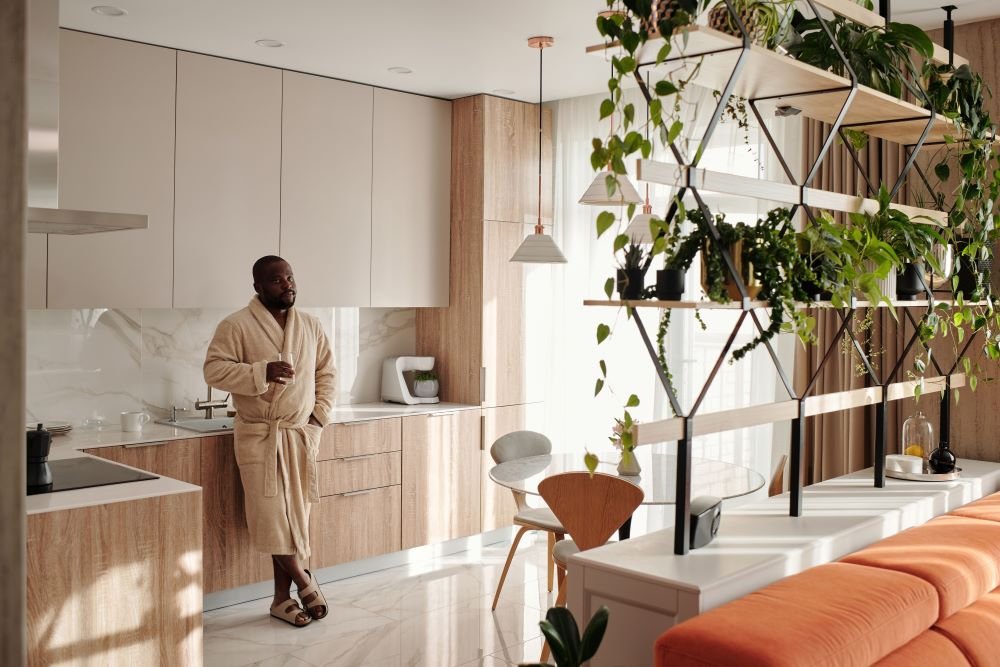
Living with someone who cheated does not always feel like a crisis.
Sometimes it feels like the same house with the light turned on in a different way.
That is the part people miss when they talk too quickly about endings and decisions. The furniture is where it was. The kettle still boils. The same hallway still creaks when someone walks down it. But the room is no longer neutral. Nothing has physically changed, and still everything has.
I noticed it first in the ordinary places.
The kitchen. The sink. The table. The side of the bed closest to the wall. I walked through those spaces for days, sometimes weeks, before I could say exactly what was different. I just knew the house had stopped feeling like a place that held me in the same way it did before.
The hardest part is not that the house changed. It is that the house stayed the same while you changed inside it.*
The rooms keep their shape
That is what makes it hard to explain.
A broken thing should look broken. This usually does not. The plates still stack. The mailbox still fills. The towels still hang on the same hook. There is nothing in the room that announces the truth out loud. So the truth has to be carried in silence, and silence is a bad storage system.
I started noticing that certain rooms took more out of me than they used to.
The kitchen at night, when the dishes are done and the conversation is over. The bedroom, when the lamp is off but sleep has not come. The living room, where you are both sitting in the same space and not saying the thing that has changed the shape of everything. I did not call it pain. I called it tiredness, or distance, or just a bad week. But my body knew the difference.
That is what living with someone who cheated felt like in practice for me. Not a single dramatic moment. A hundred small ones.
The chair you always sit in.
The silence after the question you did not ask.
The walk past the mirror.
The glass of water left on the counter.
The sound of a phone lighting up face down on a table.
Those things begin to accumulate a meaning they never had before.
It is hard to live inside a scene that still looks normal after the script has already changed.*
The same bed is not the same bed
There is something almost absurd about how much weight a bed can carry.
It is just a bed until it is not.
You lie there and listen to the room. You listen to breathing that is familiar and unfamiliar at the same time. You turn over. You turn back. Nothing is happening, which is the worst part. The body does not get a clean moment to call it over. It just has to keep existing in the same space where the truth now lives.
Some men sleep badly. Some sleep deeply and wake with the same low pressure under the ribs. Some get up early and take the long way to the kitchen because the room is too quiet and too full at the same time. There is no standard response. Only the sense that rest has become harder to trust.
This is where emotional detachment started to make sense in a way it had not before.
Not as a goal.
Not as wisdom.
Not as a clean answer.
Just as the thing I reached for when I needed enough distance to keep functioning in the same rooms without falling apart every time I crossed them.
If you need somewhere to put the things you are not saying yet, the letters are here.
Small objects start to matter
The strange part is how often it is not the big moments that get you.
It is the towel on the back of the chair.
The mug in the sink.
The shoes by the door.
The ring of light under the bedroom door.
The smell of coffee in the morning.
The ordinary proof that life is still moving, even while something in you has stopped moving with it.
I became very aware of objects in this phase. Not because I was sentimental. Because the objects were stable. People were not stable. Rooms were not stable anymore either, at least not in the old way. But the table stayed a table. The key stayed a key. The chair stayed a chair. My mind reached for whatever stayed put.
That can make the house feel smaller.
Or quieter.
Or both.
I did not say any of this out loud. I just started spending more time in the car, or outside, or on errands that did not need to be done yet. Not to escape exactly. More to find a place where the air did not hold the whole thing so tightly.
You do not always leave the room when you are overwhelmed. Sometimes you just start standing in it differently.*
What the day asks for
The day still asks for things.
Work.
Email.
Food.
A reply to a text.
A conversation at the table.
A bill to pay.
A child to pick up.
A face to keep steady.
That was one of the more exhausting parts of betrayal inside a shared home. There was no pause button on ordinary life. I still had to move through the day using the same hands. The routine became its own test. Not because it was impossible, but because it was so ordinary while everything underneath it was not.
That was where I learned to split myself in half for a while.
One part did the day.
One part sat somewhere else and watched.
That split is not ideal, but it is common. It let me function when the truth was too large to carry all at once. The problem is that what begins as a temporary measure can start to feel like personality. I became the one who can get through the day. The one who does not make a scene. The one who stays calm. The one who handles it.
Handling it is not the same as being untouched by it.
How the house teaches distance
If you stay long enough, the house starts teaching you where not to look.
Not that I wanted to, but my own mind did it for me.
I stopped noticing certain details. Or I noticed them too much. Either way, I was not in the room in the old sense anymore. I was filtering everything. Reading temperature. Measuring tone. Watching for what might be said and what would not be said. That kind of alertness was useful for a short stretch. It was corrosive when it became the way I lived.
My body began to adapt to that environment.
Shoulders up.
Jaw set.
Walking quietly through the house at night.
Speaking less than usual.
Keeping the face steady.
That was what it looked like when I started making myself smaller inside the same space.
I had not accepted it; I just knew I had to survive it.
There is a difference.
A man can keep sharing a house and still start living at the edge of it.*
What gets lost first
It was rarely the obvious things.
Not at first.
What I lost first was ease. Then spontaneity. Then the ability to sit in the room without calculating the room. Then the kind of attention that used to be free. That was the cost. Not just anger, and not just grief, but the steady erosion of the unthinking parts of life.
I did not usually notice that loss all at once. I noticed it in hindsight, usually after a moment that should have been ordinary and was not. A dinner that felt too long. A joke that landed badly. A silence that lasted one beat too many. By then the pattern was already there.
That was why it mattered to write things down.
Not the whole theory of the marriage. Not the full emotional archive. Just facts. The room. The time. The sentence that stayed with me. The moment my body tightened. A few honest lines could show me what the day was doing before I started pretending it was nothing.
What comes next
This was not the end of the story.
It was the point where I started understanding the shape of the place I was living in. That understanding did not change anything immediately. It did not make the next decision easier. But it gave me a clearer view of what the cost actually was, and that mattered more than I expected.
Because once I could see the house clearly, I could also see what I was still carrying inside it.
And once I saw that, I stopped confusing endurance with peace.
If you have not read the earlier piece, start with What It Costs to Carry It Alone. This one follows from it.
Pingback: What It Feels Like the Next Morning After Betrayal